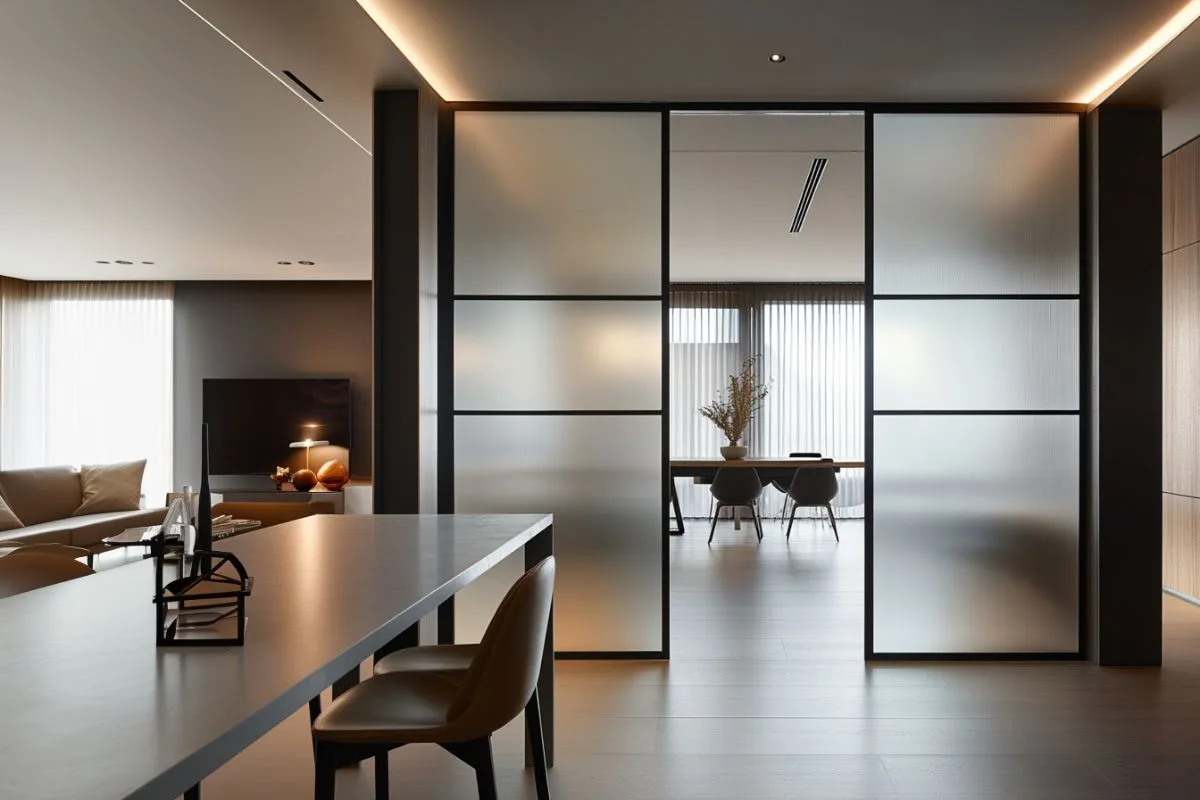
Clear glass keeps a secret from you at the showroom. It will let the daylight pour in, true, and it will also hand everyone on the pavement a clean view of your hallway. So the curtains go up. Then the blinds. Then a strip of frosted film along the bottom of the sash, and somewhere in all that the bright room you were sold has gone grey.
Etched glass is the escape hatch. The brightness stays, the view goes soft, and the result looks like a decision instead of a bodge.
It’s not a new idea. Glass etching, or French embossing if you want the older name, was already common by the mid-1800s, and it still shows up in Victorian door panels and the partition walls of glassy offices. What shifted is the money. A heritage house and a fat budget used to be the price of entry. Neither is now, which is why I keep raising it with people who are only touching one room.
Why It Looks Pricier Than It Is
The surface is doing all the work. Etching strips a microscopic skin off the glass, and that scuffed layer breaks the light into a soft frost no peel-and-stick film ever quite matches. Film lifts at the corners by the end of its first summer. Etching just stays put, for as long as the pane survives the house.
It also reads well in photographs, worth knowing if a sale is ever on the cards. The grain takes light on a slant instead of firing a hard glare back at the camera.
Then the feel of it. Drag a fingertip across a properly etched pane and there’s a fine tooth under it, the texture of cartridge paper. Cheap frosting feels like cling film pulled over a bowl. You could tell the two apart blindfolded.
Where It Earns Its Keep
Start with interior doors. A glass door between a hall and a home office spills every passing glance, every heap of paper on the desk, straight into the corridor. An etched pane closes that off, and the room stays bright.
Bathrooms next. One sheet of glass, daylight and privacy both, which is the entire brief of a bathroom window and precisely the brief that blinds fumble.
After that it’s wherever you fancy. Kitchen cabinet fronts. A stair balustrade. A waist-high screen across an open-plan flat that hints at two rooms without making you build a wall and kill the airflow. It gets on well with the sort of wall decor choices that hand a room its personality, because the logic is the same one: a surface should pull its weight or come out.
The Use Most People Never Think Of
Here’s the bit that slips past everyone.
Etching holds detail. Fine lines, lettering, the lot. So the same hands that frost a shower screen can just as easily cut your house number, a monogram, or a proper run of etched glass signs for a front entrance or a studio door.
To my mind it’s the most wasted opportunity in home design. The acupuncturist working out of a made-over front room, the photographer whose clients buzz a studio door, they nearly always settle for a printed plaque that looks like it’s on loan. Etched glass says the reverse. It says settled, and a touch serious, and the quote tends to come in under the flinch people brace for before they ask.
A timing tip while I’m here: bolt it onto the bigger home upgrades. If the doors are already off their hinges, or the joiner’s halfway through a partition, slipping an etched element in then and there runs a fraction of what the same job costs as a lonely callout half a year later.
Designing It Without Regret
One rule above the rest. Don’t overcrowd it.
People see a blank pane and treat it like a sketchpad, and the busy result ends up squabbling with everything near it. A plain border, or one clean motif, will still look right long after the ornate scene you settled on during a wet Sunday has started to grate.
Scale is the other trap. A design that looks balanced on a sample swatch can shrink to nothing on a full-height door, so make the fabricator print it at one-to-one and tape it up before a drop of acid goes near the glass. The decent ones suggest that before you do.
And light. A frosted panel reads one way with the sun behind it and another with the sun in front, so the design that dazzles against a south-facing garden can sit there dead on a dim landing. Keep the fine work where the daylight reaches.
A Word on How It’s Made
Proper etching eats into the surface with acid, which is exactly why it lives in a workshop and not on your kitchen table. The acid etching trade has a good two centuries on the clock, though these days most outfits would rather sandblast for the same effect and skip the worst of the chemistry. Both finish durable.
Looking after it is the dull, easy part. Etched faces grab fingerprints and water spots a shade more than clear glass, so a microfibre cloth and the ordinary blue spray cleaner, once a week, keeps them sharp. Just leave the scouring pads in the cupboard. They wear the contrast flat between frosted and clear, and there’s no buffing that back once it’s gone.
Why I Keep Recommending It
It answers a real problem instead of just tarting a room up. Light and privacy out of one pane. A door that says something, the moment you want it to. Decades of use and next to nothing asked back. For a single change that moves both how a room works and how it feels, I’ve yet to find much that beats it, and it’s the first thing I name when someone wants a space to finally feel done.