Luxury homes are changing.
For years, high-end residential design was often associated with obvious signs of expense: ornate finishes, complicated ceilings, decorative mouldings, polished surfaces, oversized furniture, and numerous statement pieces competing for attention.
Today, many sophisticated interiors are moving in another direction.
Instead of asking how many premium materials can be added to a room, designers are increasingly asking which materials deserve to become part of the architecture.
Natural stone fits this approach perfectly.
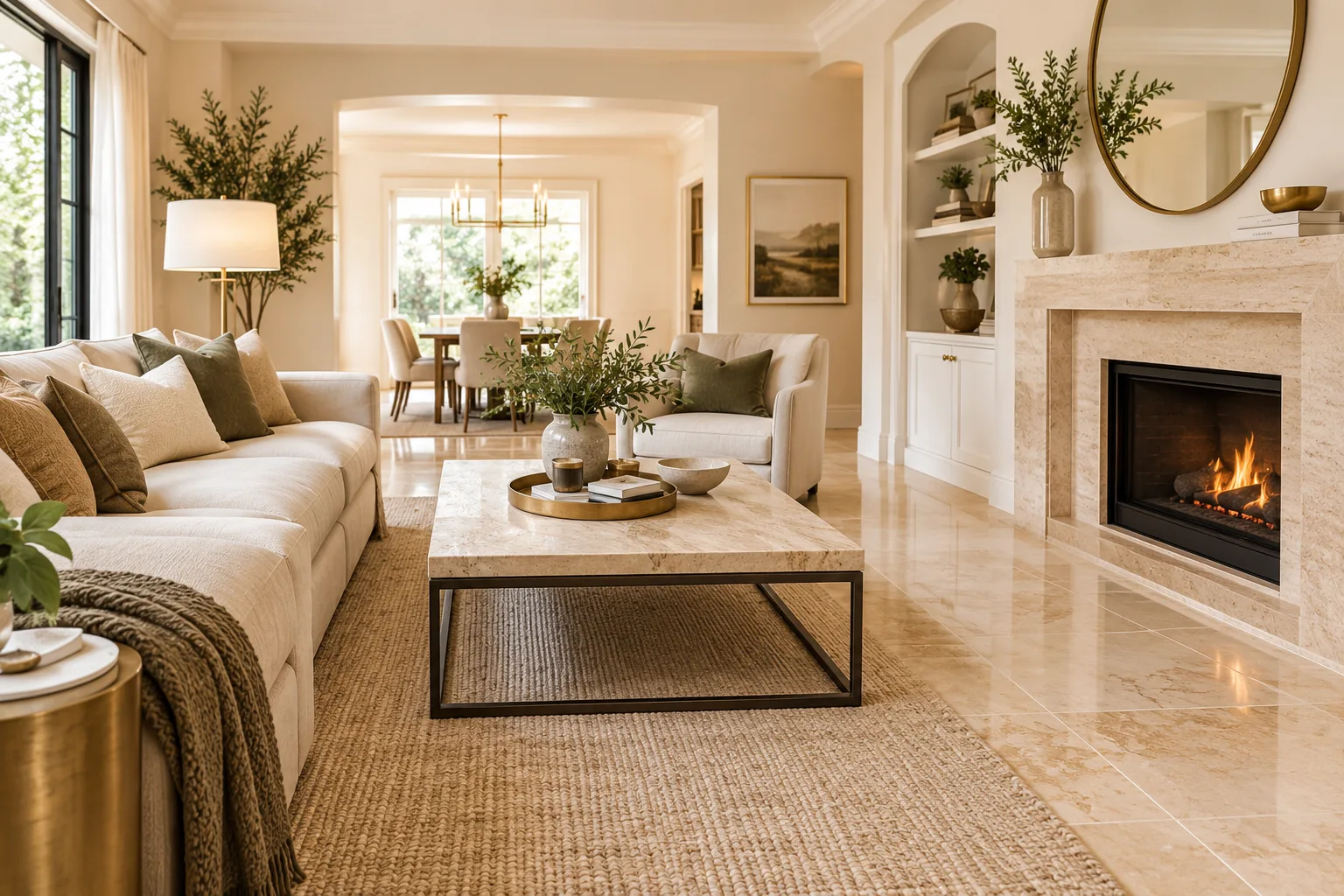
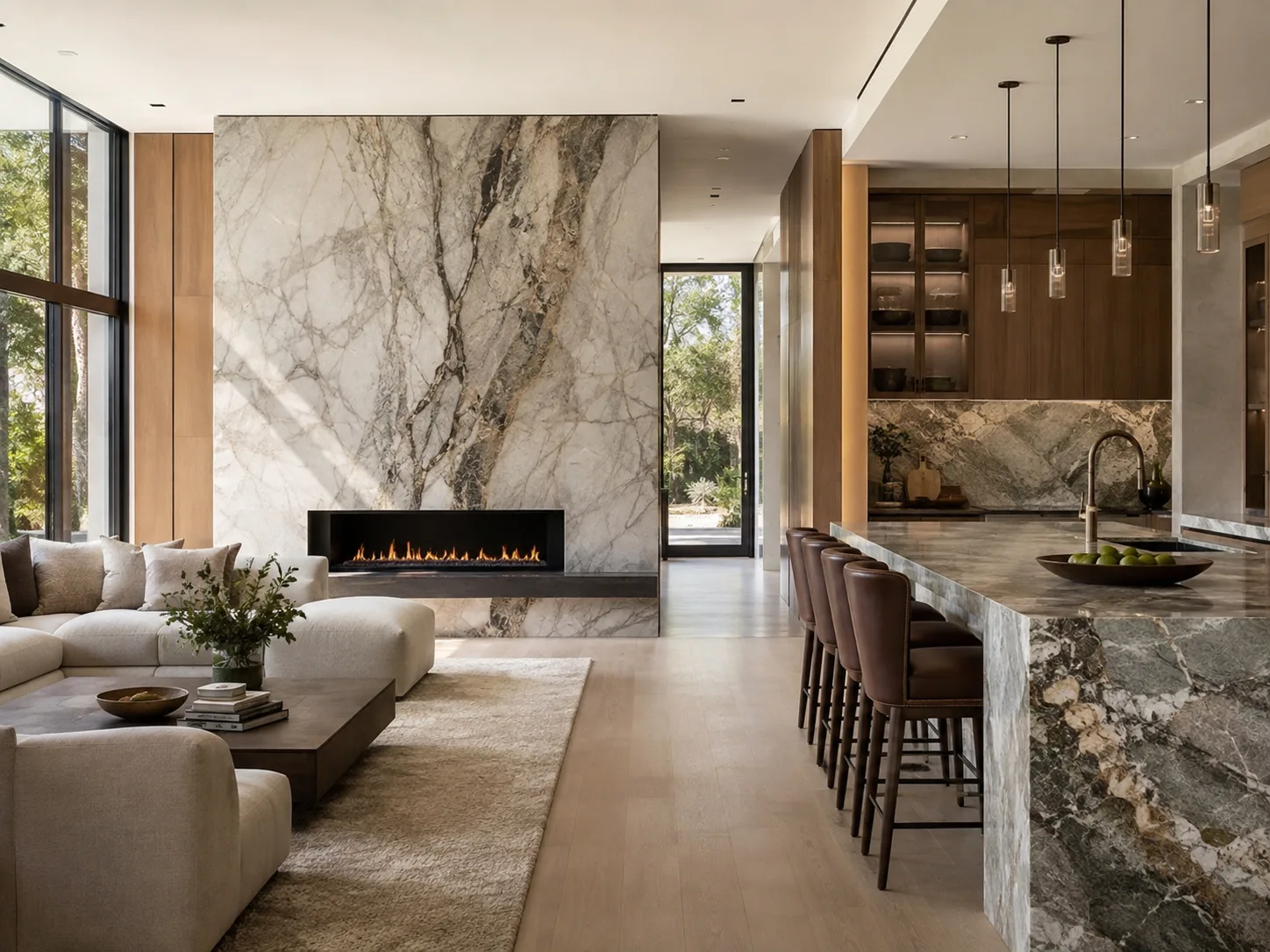
A marble fireplace can define an entire living room. A dramatic quartzite island can become the visual centre of an open-plan kitchen. A sculptural vanity can make a bathroom feel more like a private spa. A large stone feature wall can replace artwork altogether.
The result is a different kind of luxury.
It is less about decoration and more about material presence.
But using statement stone successfully requires restraint. The most dramatic slab is not automatically the best choice, and covering every surface in stone rarely creates a more sophisticated interior.
Homeowners, designers, and renovators need to understand where stone creates the greatest impact, which materials suit different applications, and how natural variation, lighting, fabrication, maintenance, and surrounding finishes affect the final result.
Why Natural Stone Has Become Central to Luxury Home Design
Natural stone offers something that is increasingly valuable in premium residential interiors: individuality.
Manufactured products are often created to achieve consistency.
Natural stone is different.
Every slab may contain variations in:
- vein direction;
- mineral movement;
- background colour;
- contrast;
- crystalline areas;
- tonal transitions.
This means two homes using the same general type of stone can still look completely different.
That individuality becomes especially important in luxury properties where homeowners want interiors that do not feel mass-produced.
A large natural slab can act almost like an original piece of artwork.
Its appearance cannot be reproduced exactly in the next house.
Luxury Is Shifting From Decoration to Material Quality
One of the biggest changes in modern luxury design is the move toward simpler architectural forms.
Instead of adding more decorative elements, designers may use:
- cleaner cabinetry;
- larger surfaces;
- fewer materials;
- concealed storage;
- integrated lighting;
- natural textures.
When a room becomes visually quieter, the quality of each material becomes more noticeable.
A simple kitchen with exceptional stone can feel more luxurious than a highly decorated kitchen built from several competing finishes.
This is why statement stone works particularly well in contemporary homes.
The material provides complexity while the architecture remains simple.
Marble Remains One of the Strongest Symbols of Residential Luxury
Few materials have the architectural history of marble.
It has been used for centuries in important buildings, sculptures, villas, and interiors, yet it continues to work in contemporary homes.
The reason is adaptability.
Marble can appear:
- soft and minimal;
- classical;
- dramatic;
- dark and moody;
- warm and decorative;
- highly architectural.
Depending on the slab, marble can support completely different interior styles.
A pale grey stone may suit a minimalist kitchen.
A dark green marble may work beautifully in a bar or powder room.
A strongly veined white stone may become a full-height fireplace.
For designers planning marble for luxury interiors, the best results usually come from selecting the material according to the scale and function of the room rather than simply choosing the most dramatic slab available.
Where Marble Works Best in a Luxury Home
Marble does not need to cover every surface to make a strong impression.
It often works best when used selectively.
Fireplace Surrounds
Fireplaces are ideal locations because the stone can become an architectural focal point without facing the same daily wear as a kitchen countertop.
A floor-to-ceiling marble fireplace can establish the visual identity of an entire living room.
Bathroom Vanities
Marble remains popular in bathrooms because it brings softness and natural variation to spaces otherwise dominated by hard surfaces.
Feature Walls
Large marble slabs can replace traditional wall decoration.
Bookmatching can make the material even more dramatic.
Custom Furniture
Stone coffee tables, dining tables, consoles, and side tables allow marble to appear as a sculptural element rather than a building finish.
Kitchen Applications
Marble can also work in kitchens when homeowners understand its characteristics and maintenance requirements.
The decision should be based on lifestyle rather than appearance alone.
Marble Requires Realistic Expectations
The beauty of marble comes with practical considerations.
Because marble contains calcite, acidic substances can affect the surface finish.
In kitchens, substances such as:
- lemon juice;
- vinegar;
- wine;
- tomato-based foods;
may contribute to etching.
This does not make marble unsuitable for every kitchen.
It means homeowners need to decide whether natural ageing is acceptable.
Choose Marble When:
- timeless natural character matters;
- some patina is acceptable;
- the surface is decorative or moderately used;
- the homeowner understands appropriate cleaning.
Consider Another Surface When:
- a perfectly unchanged appearance is expected;
- maintenance must be minimal;
- the kitchen receives extremely demanding daily use.
The mistake is not choosing marble.
The mistake is choosing marble while expecting it to behave like a completely different material.
Statement Stone Works Best When It Has a Clear Role
Luxury design needs hierarchy.
If every surface becomes dramatic, nothing feels special.
Imagine a room containing:
- heavily veined flooring;
- a dramatic island;
- patterned cabinetry;
- decorative wall panels;
- large artwork;
- bold lighting.
Each element may be beautiful individually.
Together, they can create visual noise.
A stronger approach is to identify one major statement.
For example:
dramatic kitchen island + quiet cabinets + neutral floor
or:
bookmatched fireplace + simple furniture + warm timber
This gives the room a clear visual structure.
Why Quartzite Has Become So Attractive for Luxury Homes
Quartzite appeals to homeowners who want the individuality of natural stone but also need a material capable of playing a demanding architectural role.
Some varieties are calm and subtle.
Others contain extraordinary geological movement.
Depending on the stone, colours may include:
- white;
- grey;
- green;
- blue;
- gold;
- brown;
- black.
This range makes quartzite particularly useful for homes where the stone needs to become a major feature.
One of the strongest applications is the kitchen island.
An oversized island provides enough uninterrupted surface area to display the movement of a full slab.
Quartzite Can Become the Artwork of a Kitchen
Modern luxury kitchens often use relatively simple cabinetry.
That creates an ideal setting for a dramatic natural slab.
A large exotic quartzite island can introduce colour, geological movement, crystalline detail, and visual depth without requiring additional decorative patterns throughout the kitchen.
This approach works especially well when surrounding materials remain restrained.
For example:
quartzite + walnut cabinetry + warm brass
or:
green quartzite + white oak + neutral plaster
can create a strong but balanced interior.
Choose Quartzite When:
- natural stone is important;
- stronger geological movement is desired;
- the kitchen island should become a focal point;
- a distinctive slab is preferred over repeated patterns;
- the material needs to work in a major countertop application.
Marble or Quartzite: Which Creates Better Luxury?
Neither material automatically creates more luxury.
They create different types of visual character.
Marble
Often communicates:
- timeless elegance;
- classical influence;
- softness;
- recognisable natural veining.
Quartzite
Can communicate:
- geological drama;
- individuality;
- contemporary luxury;
- stronger statement character.
The better choice depends on the house.
A classical villa may feel more natural with marble.
A contemporary open-plan residence may benefit from an expressive quartzite island.
Large Kitchen Islands Are Becoming Architectural Furniture
In many modern homes, the island is no longer simply a cabinet with a worktop.
It acts almost like a permanent piece of furniture.
It may serve as:
- preparation surface;
- breakfast table;
- social space;
- visual divider;
- storage;
- entertaining area.
Because the island is often visible from multiple rooms, the material becomes extremely important.
Large natural slabs work particularly well because fewer joints allow the geological movement to remain visible.
Waterfall Edges Can Increase the Architectural Effect
A waterfall island continues the countertop material vertically down the side.
This gives the stone more visual presence.
However, waterfall design should be planned before fabrication.
For directional marble or quartzite, the fabricator needs to determine how the vein will continue from the horizontal surface to the vertical panel.
Poor alignment can make premium material look randomly assembled.
If the Slab Has Strong Movement
→ Plan the waterfall layout carefully.
If the Pattern Cannot Be Continued Successfully
→ A conventional edge may produce a better result.
Do not add a waterfall simply because it is associated with luxury.
Feature Walls Are Replacing Traditional Decoration
Another reason statement stone is becoming popular is that it can replace multiple decorative elements.
A dramatic wall may eliminate the need for:
- large artwork;
- decorative panelling;
- multiple colours;
- complex accessories.
This can make the interior feel cleaner.
Potential locations include:
- living rooms;
- dining areas;
- foyers;
- bathrooms;
- stair halls;
- fireplaces.
Bookmatching Can Turn Stone Into Architectural Art
Bookmatching arranges adjoining slabs so their patterns mirror one another.
This can produce strong symmetry.
The technique works particularly well with stone containing clear directional movement.
Before fabrication, designers should confirm:
- wall dimensions;
- slab sequence;
- central axis;
- furniture position;
- fireplace or television location;
- lighting.
A beautiful central vein has little value if it disappears behind a television.
Luxury Bathrooms Are Becoming More Material-Focused
High-end bathrooms increasingly use fewer surface materials.
Instead of combining several decorative tiles, designers may use large-format stone across:
- vanity areas;
- shower walls;
- tub surrounds;
- feature walls.
This creates visual continuity.
The bathroom feels calmer because fewer joints and patterns interrupt the space.
If the Bathroom Is Small
Use quieter stone or limit dramatic material to one wall.
If the Bathroom Is Large
More expressive slabs can work without overwhelming the room.
Stone and Wood Are Natural Partners
One reason luxury interiors feel comfortable rather than cold is the balance between hard and soft materials.
Stone provides:
- visual weight;
- mineral texture;
- permanence.
Wood provides:
- warmth;
- natural grain;
- softer colour.
Popular combinations include:
- white marble + walnut;
- quartzite + oak;
- green stone + dark timber;
- beige stone + light oak.
The combination often feels richer than either material used alone.
Metal Can Change the Personality of Stone
Metal details can push the same stone in different directions.
Brass
Adds warmth and can emphasize gold mineral movement.
Bronze
Works beautifully with brown, cream, and green stones.
Black Metal
Creates stronger architectural contrast.
Stainless Steel
Supports a cleaner contemporary look.
The metal should support the stone rather than compete with it.
Lighting Can Transform a Natural Stone Surface
Lighting is one of the most underestimated parts of material selection.
Natural stone can look very different throughout the day.
Daylight may reveal cool tones.
Warm evening lighting may strengthen cream, beige, gold, or brown.
Polished stone reflects more light.
Honed surfaces create a softer appearance.
For statement walls, designers may use:
- wall washers;
- concealed LEDs;
- directional spotlights.
Good lighting reveals the material.
Poor lighting can flatten it.
Full Slab Selection Matters More Than Small Samples
Natural stone should be evaluated at the largest practical scale.
Small samples cannot show:
- complete vein movement;
- large colour transitions;
- mineral concentrations;
- dramatic geological patterns.
For a major feature, request full slab photographs or inspect the slab directly.
If several slabs are required, review them together.
Natural variation should look intentional across the finished installation.
Do Not Expect Natural Stone to Be Perfectly Uniform
Uniformity is often desirable in manufactured materials.
Natural stone should be approached differently.
Variation is part of what gives it identity.
The goal is not to eliminate variation.
The goal is to manage it.
For example:
- use compatible slabs in one large area;
- distribute variation intentionally;
- reserve the strongest slab for the focal location.
Fabrication Can Make or Break the Design
A luxury slab does not guarantee a luxury result.
Fabrication affects:
- seams;
- edges;
- corners;
- vein continuity;
- sink openings;
- waterfall joints;
- panel alignment.
A poorly placed seam can interrupt an important vein.
An oversized sink opening can remove the most attractive part of the slab.
This is why layout should be approved before cutting.
Choose Stone According to the Room’s Scale
Scale matters.
A pattern that looks beautiful in a huge showroom may overwhelm a compact residential space.
Small Rooms
Consider:
- lighter backgrounds;
- moderate veining;
- one focal surface.
Large Rooms
Can support:
- broader movement;
- darker colours;
- large bookmatched installations;
- oversized slabs.
The material should feel proportional to the architecture.
Common Mistakes When Using Statement Stone
1. Selecting the Most Dramatic Slab Automatically
Drama only works when the room can support it.
2. Using Statement Stone Everywhere
Luxury requires hierarchy.
3. Ignoring Furniture
Large furniture may cover important patterns.
4. Choosing From Small Samples
Natural slab movement needs to be reviewed at scale.
5. Forgetting Lighting
Stone colour changes under different conditions.
6. Planning Fabrication After Buying the Slabs
Layout should influence cutting.
7. Choosing Only by Trend
Natural stone may remain in the house for decades.
A Simple Stone Selection Framework
If the Home Has Classical Architecture
→ Consider marble and other timeless natural stones.
If the Home Is Minimal and Contemporary
→ Consider one strong quartzite or marble focal point.
If the Room Already Contains Patterned Timber
→ Choose quieter stone.
If the Interior Feels Too Cold
→ Combine stone with timber, upholstery, rugs, and warmer lighting.
If You Want a Statement Island
→ Select the full slab before designing the cutting layout.
If You Want a Feature Wall
→ Plan furniture, lighting, joints, and viewing angle first.
If Low Maintenance Is Critical
→ Evaluate the actual material characteristics before committing to appearance alone.
Micro Summary
Luxury homes increasingly use marble, quartzite, and statement stone because natural materials can create individuality without excessive decoration.
Marble works particularly well when timeless elegance matters, while quartzite can create stronger geological drama for kitchens and feature surfaces.
If you want quieter classical luxury → consider marble.
If you want a bold natural focal point → consider expressive quartzite.
The best results come from using statement stone selectively and planning slab selection, lighting, fabrication, and surrounding materials together.
Final Recommendation: Use Less Stone, but Make It Matter More
The goal of statement stone should not be to prove how much expensive material a home contains.
It should create visual identity.
Choose the locations that matter most.
That may be:
- the kitchen island;
- fireplace;
- bathroom;
- entrance;
- dining-room wall.
Then allow those surfaces to lead the design.
Keep surrounding materials simpler.
Review complete slabs.
Plan vein direction.
Coordinate lighting.
Think about furniture placement.
Understand maintenance.
And involve the fabricator before cutting begins.
A luxury home does not need marble on every wall or dramatic quartzite on every countertop.
Often, one exceptional slab in exactly the right place creates more impact than an entire room filled with premium materials.
That is the real strength of natural stone.
Its geological movement, variation, and individuality allow the material itself to become part of the architecture.
When used with restraint, marble and quartzite do not simply make a home look expensive.
They make it feel considered, permanent, and unmistakably individual.
Frequently Asked Questions
1. Why is marble used in luxury homes?
Marble is commonly used in luxury homes because it offers natural veining, individual slab variation, and a timeless appearance associated with architecture and interior design.
It can be used for fireplaces, bathrooms, feature walls, furniture, and selected kitchen applications.
If timeless elegance is important → marble is a strong option.
2. Is quartzite good for luxury kitchens?
Yes. Quartzite can be particularly suitable for high-end kitchen islands and countertops because it combines natural geological character with strong countertop potential.
Some quartzites contain dramatic movement, unusual colours, and crystalline areas that make the island a major focal point.
For best results, review the actual slab and plan the fabrication layout before cutting.
3. Is marble or quartzite more expensive?
Prices vary significantly for both materials.
Factors include:
- stone variety;
- rarity;
- quarry availability;
- slab size;
- appearance;
- transportation;
- fabrication.
Some exotic quartzites can be more expensive than common marble, while rare marble varieties can also command very high prices.
The material name alone does not determine cost.
4. What stone is best for a luxury feature wall?
Marble and quartzite are both strong choices.
Marble can create elegant, timeless feature walls, while quartzite may provide more dramatic geological movement and unusual colours.
If the room needs calm sophistication → consider marble.
If the wall should become the main artwork → consider expressive quartzite.
5. Does natural stone increase the luxury feel of a home?
It can, but material alone does not create luxury.
Slab selection, scale, fabrication, lighting, furniture, surrounding materials, and restraint all affect the result.
One carefully planned stone focal point can often look more sophisticated than using expensive stone across every available surface.
The strongest interiors use natural stone because it supports the architecture—not simply because it is costly.