Picking a Roof Color That Complements Your Exterior Palette
The roof can take up a big share of what people see when they look at a house from the street, yet its color often gets picked in a hurry from a two-inch sample chip on a contractor’s counter. A roof stays put for decades and costs a lot to change, so its color deserves the same care you’d give the front door, the siding or the landscaping. Here’s how to choose a shade that pulls the whole exterior together.
Start with what you can’t change
Before looking at a single sample, list the parts of the exterior that are fixed or expensive to change:
- Brick or stone. Masonry carries its own undertones, warm (red, orange, buff) or cool (gray, charcoal, white).
- Siding. Fiber cement and vinyl can be repainted or replaced, but not cheaply.
- Hardscape. Driveways, walkways, retaining walls and pavers.
- Surroundings. Mature trees, neighboring houses and any HOA or historic-district guidelines.
Your roof should work with those elements, not fight them.
Match warm with warm, cool with cool
The most dependable rule in exterior color is to keep undertones consistent.
- Warm palettes, such as red brick, cream or tan siding and bronze fixtures, pair well with brown, weathered wood, terracotta and warm multi-tone shingle blends.
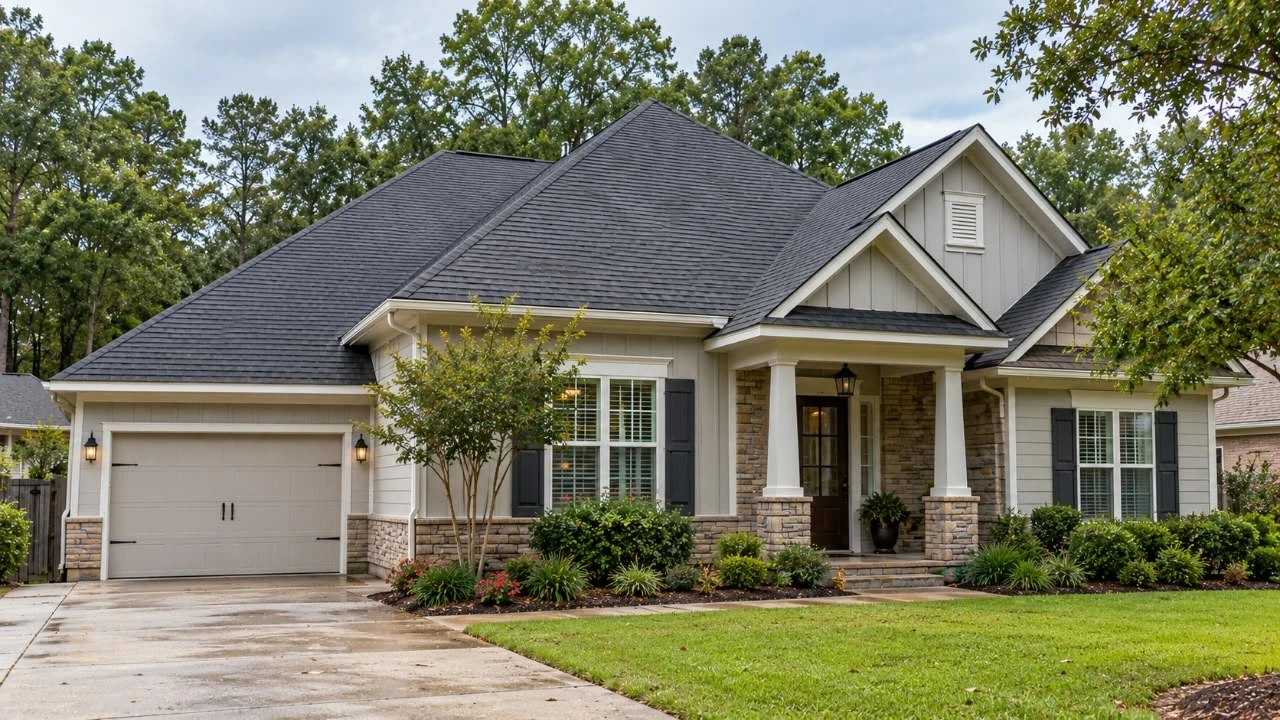
- Cool palettes, such as gray, white, blue or sage siding, look sharp with charcoal, slate gray, black or blue-gray roofing.
- Neutral palettes give you room to play. A crisp white farmhouse can wear a black metal roof for contrast or a soft gray shingle for a quieter look.
Contrast or blend?
High contrast, a dark roof over light siding, makes a house look crisp and defined and emphasizes rooflines. It suits modern farmhouse, Craftsman and many traditional designs.
Low contrast, a mid-tone roof over mid-tone siding, creates a soft, cohesive look that often works on Mediterranean, Spanish and cottage styles.
Neither is wrong. Just choose one direction on purpose instead of ending up halfway between.
Color changes how hot the house runs
In hot Southern climates, roof color affects comfort and power bills, not just looks. Darker roofs absorb more sunlight and push more heat into the attic. Lighter and specially formulated “cool” roofing reflects more of it.
The effect can be significant. The U.S. Environmental Protection Agency notes on its cool roofs page that in air-conditioned homes, solar reflectance from a cool roof can reduce peak cooling demand by 11 to 27 percent. For a house in South Louisiana or the Texas Gulf Coast, where the air conditioner runs hard for months, that’s a real factor in the color decision.
The good news is that you no longer have to choose between a dark look and a cool roof. Many shingle and metal manufacturers now offer reflective granules and pigments in darker colors. When comparing products, ask for the solar reflectance and thermal emittance ratings, which are often listed with the Cool Roof Rating Council.
In humid regions, lighter roofs can also show the dark streaks of algae growth sooner. Look for shingles with algae-resistant granules, often copper-based, which most major manufacturers offer in their warranty-backed lines.
Let the architecture guide you
- Colonial and traditional: charcoal, black or weathered wood.
- Craftsman: earthy browns, deep greens or multi-tone blends.
- Modern farmhouse: black or dark bronze metal, charcoal shingles.
- Acadian and Creole cottages: slate gray, weathered wood or a galvanized-look metal.
- Mediterranean: terracotta or warm clay tones.
On the Northshore of Lake Pontchartrain, you’ll see plenty of all of these within a few streets. Older cottages and raised houses around downtown Covington often look best in a quiet gray or galvanized metal, while newer subdivisions with brick fronts usually call for a warm blend that picks up the mortar color.
How to test before you commit
- Look at large samples outdoors, not under showroom lights. Hold them against your siding and trim at morning, noon and late afternoon.
- Drive the neighborhood and photograph roofs you like, especially on homes with brick or siding similar to yours.
- Use a manufacturer’s online visualizer. Upload a photo of your house and try several colors side by side.
- Step back to the street. Roof colors read lighter from a distance and in full sun than they do in your hand.
- Check HOA and historic rules before you place the order.
For a deeper walkthrough, including how to read sample boards and how color can affect resale, see this guide on choosing the right roof color.
Don’t forget the trim pieces
Gutters, drip edge, vents, pipe boots and flashing are part of the roof’s look. Coordinate them with either the roof or the trim so they disappear into the design. A bright white gutter against a dark bronze roof and tan siding can make a well-chosen roof look slightly off. Many metal shops can fabricate gutters and edge metal to match the roof color exactly.
Skylights, solar panels and satellite dishes also deserve a thought. Dark frames and mounting hardware usually blend best with darker roofs, and placing equipment on rear-facing slopes keeps the street view clean.
Get help from someone who has seen it installed
A good roofer will bring large samples to the house, show you finished projects with similar palettes and help you weigh appearance against heat performance and durability. Northshore homeowners can ask a local roofing contractor in Covington for addresses of completed jobs with similar brick or siding, then drive by at different times of day. Seeing a full roof in real light, on a house like yours, settles most color debates faster than any sample board.
A shortlist that works
If you’re stuck, narrow the field to three candidates: one that blends, one that contrasts and one cool-rated option in the color family you like. Put all three samples against the house on a sunny afternoon, take photos from the curb and look at them on your phone the next morning. The one you keep coming back to is usually the right answer, and the photos give you something concrete to share with your household and your roofer before anything is ordered.