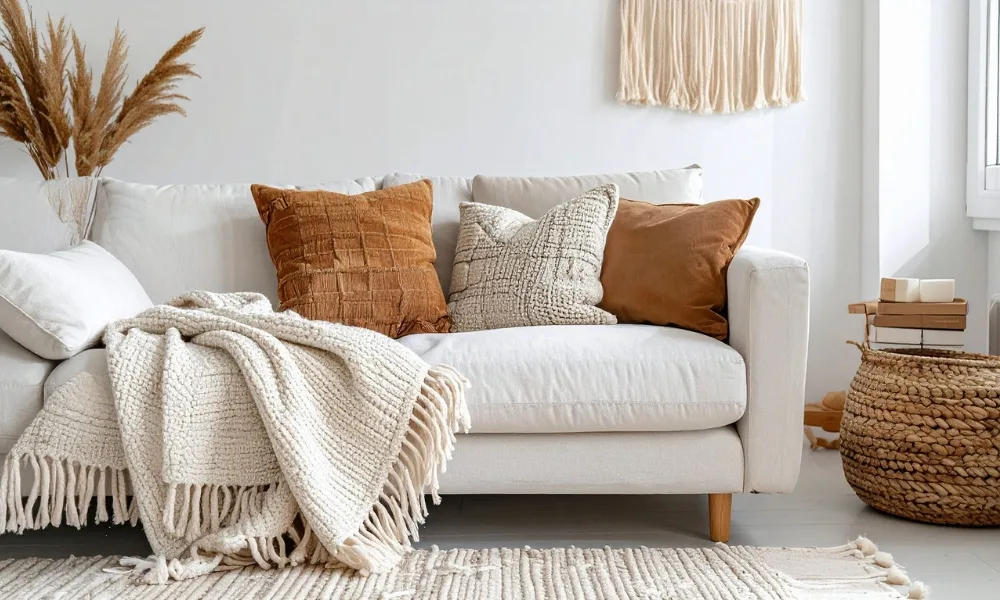
There’s a difference between a living room that’s decorated and one that actually feels like someone lives there. The first one can look perfect. Everything matches. The cushions are lined up. The coffee table has the right little tray on it. And yet… it can still feel a bit cold.
A room usually feels more interesting when everything doesn’t look like it was bought together. Different furniture. Different textures. A few older things. Some new things. Books that are actually used. Objects that have a little personality. That’s the look worth aiming for.
Don’t Make Everything Match
Matching furniture is easy. A sofa comes with two chairs, then there’s a matching coffee table, matching side tables… problem solved. Except the room can end up looking more like a showroom than a home.
Try mixing things instead. A simple modern sofa can sit with an older wooden coffee table. A clean-lined chair can work beside a more traditional cabinet. A modern lamp next to an older piece can actually make both look better. There should still be some connection between everything. Similar wood tones help. So do repeating colours or shapes. But it doesn’t need to be obvious. In fact, a little bit of mismatch is usually what makes the room feel more natural.
Texture Does More Than Another Cushion
When a room feels flat, the first instinct is often to add more decoration. Usually, that’s not what it needs. Look at the materials instead. A smooth wooden table beside a soft sofa. A wool rug underfoot. Linen cushions. A woven basket somewhere nearby. Maybe a stone bowl or ceramic vase. Just different surfaces sitting next to each other. That small change can make a room feel much warmer. And it doesn’t depend on having expensive furniture.
Natural materials are especially useful here because they already have small variations in colour and texture. Wood has grain. Stone is never perfectly uniform. Linen has that slightly relaxed look that makes everything around it feel less formal. It’s also worth not going overboard. Five different textures fighting for attention will just make the room feel busy. A few is enough.
Put Things You Actually Like on Display
This sounds obvious, but it gets missed all the time. Walk around the room and look at the decorative stuff. Does it actually mean anything? A shelf doesn’t need ten matching vases because an empty shelf feels uncomfortable. Put a few books there. Add something picked up while travelling. A family photograph. A piece of pottery. An old frame. Even something completely random can work if it feels like it belongs there. And no, every object doesn’t need a story behind it. Sometimes a weird little bowl just looks good. That’s fine.
The bigger mistake is filling every available surface. Shelves need empty space. Coffee tables need empty space. Even a console table looks better when everything is not pushed together. Try grouping two or three things, then leaving a gap. It looks less forced.
Lighting Changes the Whole Room
A living room can look completely different at night just because of the lighting. One bright ceiling light usually doesn’t help. A floor lamp beside the sofa is better. Add a table lamp on a console or side table. If there’s a reading chair, give it its own light. Now the room has different little pockets of light instead of one bright wash over everything.
Warm light also tends to work better in living rooms. It makes wood look richer and soft fabrics feel softer. There’s no need to make the room dark, either. The point is simply to have options. Bright when needed. Soft when not. That small bit of control makes a surprisingly big difference.
Add Something Green
Plants are an easy fix for a room that feels too hard or too structured. A tall plant in an empty corner can break up a wall of furniture. A smaller plant on a shelf can soften a collection of books and frames.
Flowers work too. So do branches in a large vase, depending on the room. But this doesn’t mean filling every corner with greenery. One large plant in the right place is often much better than lots of tiny plants sitting everywhere.
The same goes for baskets, timber and other natural materials. A little bit can make the room feel warmer without turning it into a themed space.
Make Sure It Still Works as a Living Room
This is where styling can go wrong. A room can look great in a photo and be completely annoying to use. The coffee table is too far away. There’s nowhere to put a drink. The chair blocks the walkway. The lamp looks good but cannot actually be reached from the sofa. None of that is a styling success.
Furniture should make sense first. Think about where people sit, where they walk, where they put things down. If the room is mainly used for watching television, that matters. If it’s used for conversation, reading or having guests over, that matters too. The decoration comes after that.
Leave Some Things Alone
Not every old piece needs replacing. That slightly scratched wooden table might actually be the thing giving the room some character. The cabinet with an imperfect finish may look much more interesting than another perfectly smooth storage unit. For anyone looking to bring that kind of contrast into a newer room, antique furniture can work surprisingly well alongside contemporary pieces.
The trick isn’t turning the entire room into an old-fashioned space. One older piece can be enough. Then keep the rest fairly simple around it.
The Room Doesn’t Need More Stuff
This is probably the easiest thing to forget. When a room feels unfinished, adding something is tempting. Another cushion. Another vase. Another frame. Sometimes the better move is to take something away. Clear one corner. Remove something from the coffee table. Leave part of a shelf empty. Then look at the room again. A space feels hand-picked when there’s a bit of thought behind what’s there and also what’s not there.
Different furniture, mixed materials, useful lighting, a few personal things and one or two pieces with some age can do most of the work. It shouldn’t look perfect. It should look like the room has developed over time. That’s what makes it feel like home.