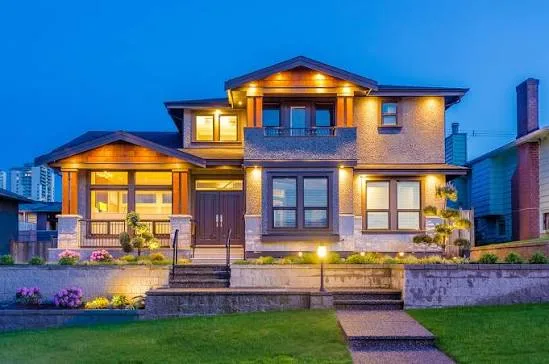
Solar exterior lamps increase curb appeal by showcasing your dream house at night time, when you highlight your architectural features, your landscaping, or your pathways, all with no electrical cord or digging required. Since the lighting units contain their own solar panels and batteries, you are free to set and re-arrange them as necessary until you achieve the desired effect. You finally come up with a house that is perceived as being taken care of and well planned at all times, which in turn will be the very factor that attracts the potential buyers and walkers alike.
It’s not just during the day that curb appeal makes a difference. About half of the time, someone sees your house from the street, the daylight has already set in. A house with no windows open and an unlit exterior appears to be quite a missed opportunity. Solar lamps can be the cheapest and easiest solution to this matter, besides, they do not come with the same hassle as the installation of a wired lighting system. Because of this, people use the latter when they are in need of doing some improvements within a weekend and do not have to wait for a professional to carry out a renovation project.
What Solar Landscape Lighting Actually Does for Your Home’s Appearance
The purpose of landscape lighting is layering and variation. Illuminating a flat area with only a few light sources from above will only leave a blank, uninteresting space. Then again, a composition of a few trees getting illuminated from underneath, a low glow line following the path and a gentle highlight at the front entry will give a sense of depth in the garden and lead an individual where one wants them to go. Solar lighting helps with such layered composition because the placement of lights is not restricted solely to areas where cables lie under the surface. You can install a bulb beneath the maple tree simply because the maple tree deserves to be lighted, not because that’s the spot the wire ended up reaching.
Different light fixtures have different roles. Uplights placed at the foot of a tree or column shine light upwards to reveal the tree’s texture and the height of structures. Path lights emit light downwards to delineate a path and let you feel welcome as you approach it. Spotlights emphasize one feature like a stone chimney or a sculpture in a garden. Mastering the combination is essential to distinguish a landscape that has been professionally designed from that of lights simply planted in the soil without a clear idea of their placement.
Finish and color temperature also contribute a great deal alongside location, as far as lighting is concerned. A warm white light range between 2700K and 3000K is great for complementing brick, timber and stone, while it also makes people feel safe and friendly. A lighter, cooler light of around 5000K, then again, appears harsh and may actually make a warm-colored house seem colder. Actually, most people who use a warmer light color express fewer regrets than those who went too cold. Because of this, when in doubt, always opt for warmer colors since you don’t want your home to be mistaken for a salesroom.
How Solar Lights Compare to Wired Systems on Cost and Effort
The first thought that pops up is the difference in installation costs. A low-voltage wired system normally requires a transformer, buried cables, and an electrician, all of which are reasons why even a fairly small front yard job will easily cost hundreds of dollars before you’ve purchased a single light fixture. With solar lighting, all that stuff gets bypassed. There’s no excavation, no transformer to figure out, no permit to hassle with, so the only actual expense lies in the lights. Single solar lights may be from 10 dollars each for basic path lights up to around 40 or 60 dollars for a much brighter spotlight and better-built model. A decent eight- to twelve-fixture front-yard installation will be about 100 to 400 dollars based on quality, and after you stake them in the ground, all you have to do is push the stakes into the ground and you’re done within a day that’s it. There’s no wiring diagram, no voltage drop you need to calculate.
We all agree that being honest to ourselves as to the trade-off is good. A solar lighting system does need sunlight, and a solar-powered light that resides in a deeply shaded spot under a thick canopy of trees will rarely get fully charged and will start to fade before daybreak. Both battery life and light intensity have really enhanced in recent years, and industry research also indicates that the latest LED solar lights, even on winter days, can operate several hours on a full charge. Still, with constant, always-on illumination, brightness is what makes a wired system preferable. Except solar lighting is good enough without floodlight-level output since most people are just looking for accent and atmosphere in the areas around the house.
Choosing Fixtures That Survive Weather and Actually Last
Cheap solar lights are known for not lasting even a season, and that reputation is mostly deserved, but it turns out mainly to be due to a few weak points that you can easily shop around for. The first thing to note is the battery. Cheap devices usually have little nickel-cadmium batteries that wear out quite fast, while better versions use lithium or, even better, higher-capacity NiMH batteries. It will take about 2 to 3 years for them to noticeably weaken the output.
The third major component is the panel and the housing, respectively. Monocrystalline solar panels are much more efficient than the cheaper polycrystalline versions, which is actually quite significant during short winter days as well as in partial shade conditions. When it comes to the housing of the unit, you should get a fixture with an IP rating of IP65 or higher since that will mean the unit is really rain- and sprinkler-resistant instead of merely splash-proof. In fact, stainless steel and die-cast aluminium are much stronger than plastic, which is a thinner material. That is why metal housing will definitely outlast plastic ones, mostly when you take into account that freezing-thawing cycles will crack cheaper materials.
If you want fixtures that hold their brightness and finish past the first summer, it’s worth buying quality solar powered lights rather than grabbing the cheapest multipack you can find, because the price difference usually reflects real differences in battery, panel, and build. A useful habit before you commit to a dozen of anything is to buy one or two, live with them for a few weeks through a cloudy stretch, and see how they actually perform on your property before scaling up.
Placement Strategies That Make the Biggest Visual Impact
The best things that read from the street are the textured, towering things. A totem pole of a big tree glowing from below, a single column of porch is strong enough to stand alone, or a textured stone wall all reflect light onto the facade in a more dramatic way than a plane form can. Begin with the dramatic. Two or three well-placed uplights on the strongest trees or architectural features have more visual impact from the street than a dozen path lights along the driveway.
Symmetry growing in the entrance pulls together the façade. Symmetrical fixtures to flank the front door or the garage boundaries draw attention to the house and guide the eye- the reason lighting designers love to use pairs and duplicates. On a garden path, path lights are spaced at 6 or 8 feet apart so the pools of light unify without becoming a seamless runway.
And angles are positioned so the light falls on the garden feature and not a bedroom window or a face. The type of property affects the method. A snug cluster of houses with a modest front yard can benefit from a minimum of subtle highlights, perhaps a couple of lights on each porch and one to accent a feature, because cluttering a cramped site with too many fixtures is unintended. A more substantial, family-friendly suburban house can support a more complete scheme, with spacious layers of tree illumination, a step lighting feature down a long walkway and details about a large-scale house. The error at both ends is repetition. The black space between lit features is necessary to the effect and a garden with a candlepower in every square foot dissipates the contrast that worked so well.