Hurricane Proof House: Complete Guide to Design, Cost, & Plans
Every year, hurricanes cause an almost $28 billion in damage across the United States. The good news is that modern engineering makes it possible to build homes that survive even the worst storms.
No home is 100% hurricane-proof. But with the right design, materials, and plans, you can build a home that is hurricane-resistant enough to shelter in place through a Category 4 or 5 storm. This guide covers everything you need to know.
Looking to build or buy a hurricane proof house? This guide covers everything, materials, designs, floor plans, cost, prefab options, and real-world examples from Florida, Jamaica, Sullivan’s Island, and Pensacola Beach.
What Is a Hurricane Proof Home and How Is It Designed?
A hurricane proof house is built to resist the three main forces a storm throws at it: high-speed winds, flying debris, and storm surge flooding. No single feature makes a home hurricane-proof. It is the combination of shape, materials, foundation, roof, windows, and doors working together as a system.
After Hurricane Andrew caused $16 billion in damage in 1992, Florida rewrote its building code. Since then, homes built to modern Florida standards must use missile-impact glass, concrete or masonry walls, hurricane-strapped roofs, and reinforced connections from roof to foundation (Wikipedia, Hurricane-proof building).
What Are the Key Hurricane Proof House Design Principles?
According to Fontan Architecture — a firm that has rebuilt homes after Superstorm Sandy — and structural engineers cited in Wikipedia’s hurricane-proof building article, these are the core design rules:
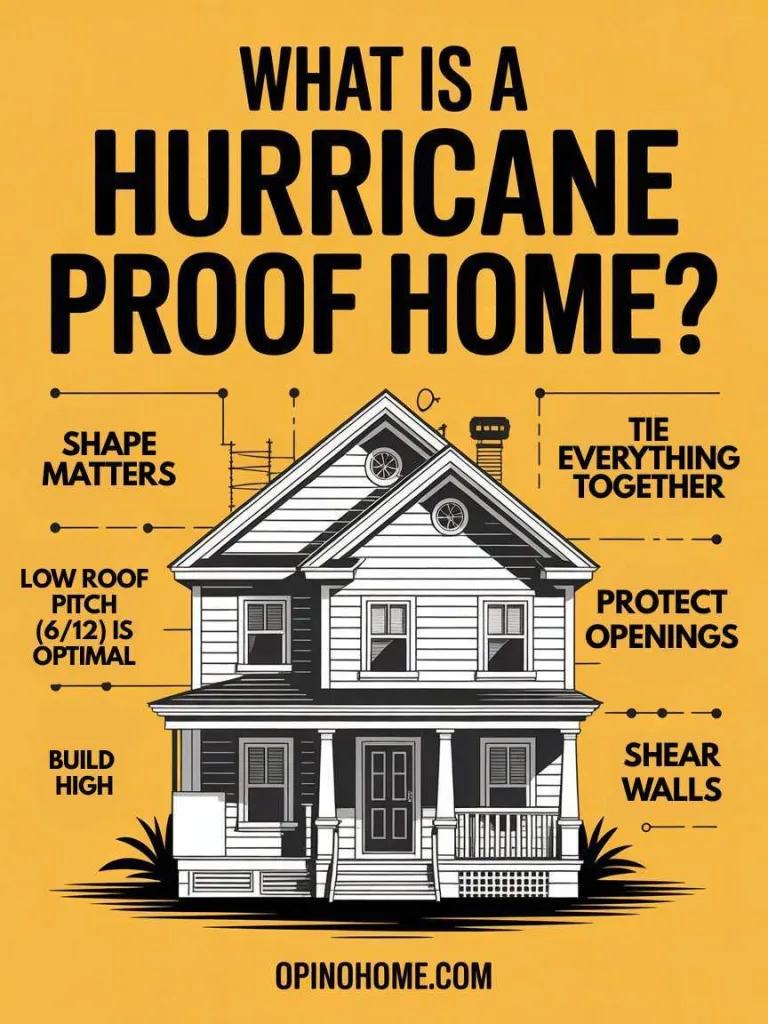
- Shape matters: Round and multi-sided homes deflect wind better than square homes. Wind can’t build pressure on a curved surface the way it does on a flat wall.
- Hip roofs, not gable roofs: A hip roof slopes on all four sides. It sheds wind better and creates less uplift than a gable roof with two flat end walls.
- Low roof pitch (6/12) is optimal: It reduces the lifting force the wind can get under the roof.
- Build high: Elevated foundations prevent storm surge flooding. Coastal homes should sit 5 to 14 feet above base flood elevation, a detail that experienced coastal home architects carefully plan during the design phase.
- Tie everything together: Roof, walls, and foundation must be connected with continuous metal strapping — not just nailed. Hurricane ties anchor roof trusses to walls; straps run from roof to foundation.
- Protect openings: Windows and doors are the most common point of failure. Once a window breaks, pressure builds inside and can lift the roof off. Impact-rated windows and doors rated for 150–200 mph are essential.
- Shear walls: These are reinforced walls that prevent the house from racking or tipping sideways under lateral wind loads.
- Avoid flood zones if possible: Build on high ground. Use swales (low channels) around the home to redirect water away from the foundation.
What Shape Is Best for a Hurricane Proof House Design?
Round homes outperform all other shapes in hurricane conditions. According to Deltec Homes — which has a 99.9% survival rate across 30 years of hurricanes — the circular design redirects wind pressure around the structure, reducing total wind load by approximately 30% compared to a rectangular home. The radial truss system inside (roof and floor trusses spreading out from the center like bicycle spokes) disperses wind energy across the entire structure instead of letting it build in one spot.
Monolithic dome homes are even more aerodynamic. These concrete shells have no flat surfaces for wind to push against and no separate roof to be lifted off. They are essentially one continuous piece of curved concrete.
What Are the Best Materials for a Hurricane Proof House?
Material choice is the single biggest factor in how well a home survives a hurricane. Here is a clear comparison of every major option used today.
| Material | Wind Resistance | Flood Resistance | Fire Resistance | Cost Level | Best For |
| Reinforced Concrete | Excellent | Excellent | Excellent | High | Best overall choice for hurricane zones |
| ICF (Insulated Concrete Forms) | Excellent (up to 250 mph) | Very Good | Excellent | High | Energy-efficient hurricane homes |
| CMU (Cement Block) | Very Good | Good | Excellent | Medium-High | Affordable solid-wall construction |
| Steel Frame | Very Good | Good | Excellent | High | Non-combustible, eco-friendly option |
| Wood Frame + Strapping | Moderate | Poor | Poor | Low | Budget builds — needs heavy reinforcement |
| Fiberglass (advanced) | Excellent | Excellent | Very Good | Very High | Custom high-budget builds |
Why Is Concrete the Best Material for a Hurricane Proof House?
Concrete is rated the number one material for hurricane proof homes by architects, structural engineers, and builders consistently. Fontan Architecture calls it the top choice. Concrete Network confirms ICF walls can withstand wind speeds up to 250 mph, well above the Category 5 threshold of 157 mph.
Concrete has high compressive strength, does not burn, does not rot, resists termites, and stands up to flying debris. Poured-in-place and precast concrete options both work well. ICF (Insulated Concrete Forms) adds energy efficiency to the mix — reducing heating costs by up to 44% and cooling by 32% compared to wood-frame homes (Concrete Network).
What Makes a Concrete Hurricane Proof House Different from a Standard Build?
A standard stick-frame home uses wood studs nailed together. A concrete hurricane proof house uses walls poured or assembled as one solid reinforced unit. There are no seams or gaps for wind to exploit. Onx Homes, which builds in Florida, describes it this way: ‘No seams, no gaps. Just one solid, continuous wall.’ Their monolithic walls are poured with steel-reinforced concrete using robotics, and the homes are engineered to withstand sustained winds up to 175 mph — stronger than a Category 5 (Onx Homes press release, 2025).
Companies like Spancrete/ForeverHome have built precast concrete homes on the Gulf Coast that look identical to traditional wood-frame homes from the outside, while withstanding lateral winds exceeding 165 mph — at a price point of around $175,000 turnkey (Builder Online).
What Do Hurricane Proof House Plans and Floor Plans Look Like?
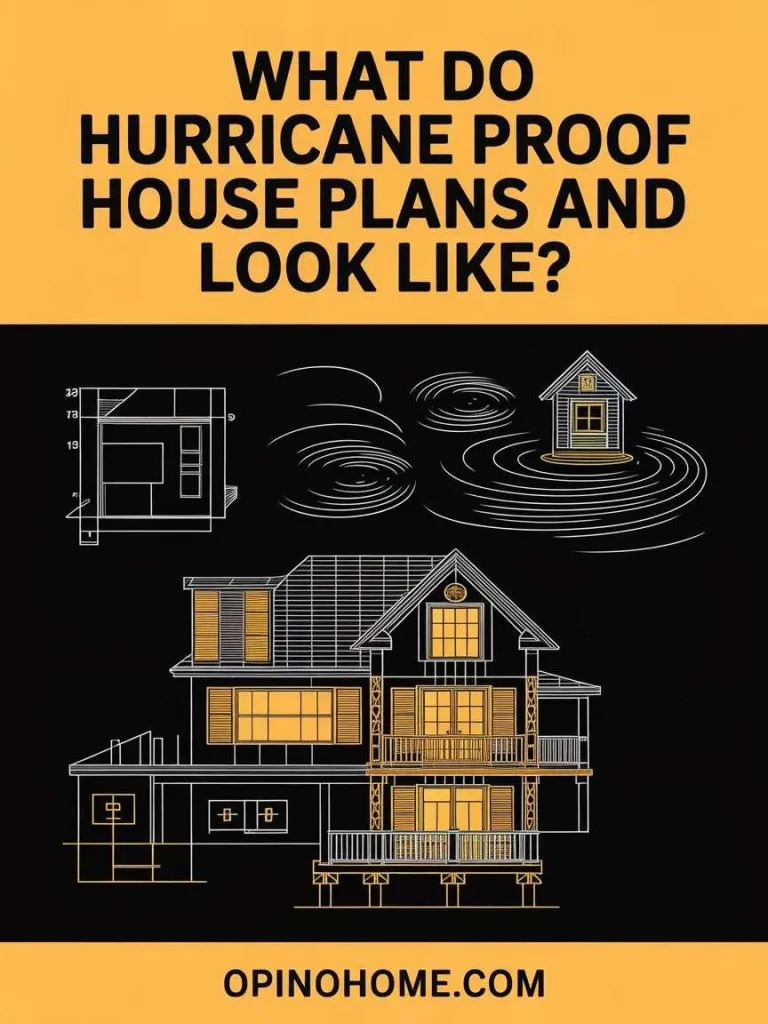
Good hurricane proof house plans start with the shape of the structure and work outward. The floor plan, roof design, wall connections, and window placement all affect how well the home handles a storm. Here is what to know before you design or order plans.
What Are the Best Hurricane Proof House Plans to Choose?
The best hurricane proof house plans share these structural features regardless of size or style:
- Hip roof design — slopes on all four sides, no exposed gable ends.
- Compact, square, or round footprint — reduces the surface area exposed to wind.
- Minimal roof overhangs — large overhangs catch wind and create uplift.
- Reinforced interior shear walls at regular intervals.
- Continuous load path — every connection from roof to foundation is tied and strapped.
- Impact-rated windows and doors rated to the local wind zone.
- Elevated first floor — on pilings or raised slab, depending on flood zone.
What Do Simple Hurricane Proof House Plans Look Like?
Simple hurricane proof house plans tend to be single-story, compact, and rectangular or square. They avoid complex rooflines, dormers, and large overhangs that add wind vulnerability. The Moriviví House, designed by Marvel Architects and awarded the AIA Florida/Caribbean Honor Award for Sustainable Design, is a clean example: a simple rectangular plan with symmetrical organization around a central concrete core, shear walls on all sides, and operable wood screen panels that close as storm shutters. It can be built from concrete block, clay brick, or compacted earth depending on location (ArchDaily).
For a budget build, a single-story rectangular home with a 4:12 or 6:12 hip roof, CMU walls, hurricane strapping, and impact windows delivers solid protection at the lowest cost.
How Do Hurricane Proof House Floor Plans Handle Storm Surge?
Floor plans in coastal flood zones must account for storm surge — the wall of water pushed ashore by a hurricane. The most effective approach is an open ground floor. Instead of enclosing the lowest level, the home sits on pilings or columns with open space below. Storm surge washes through the open ground level without building up pressure against walls.
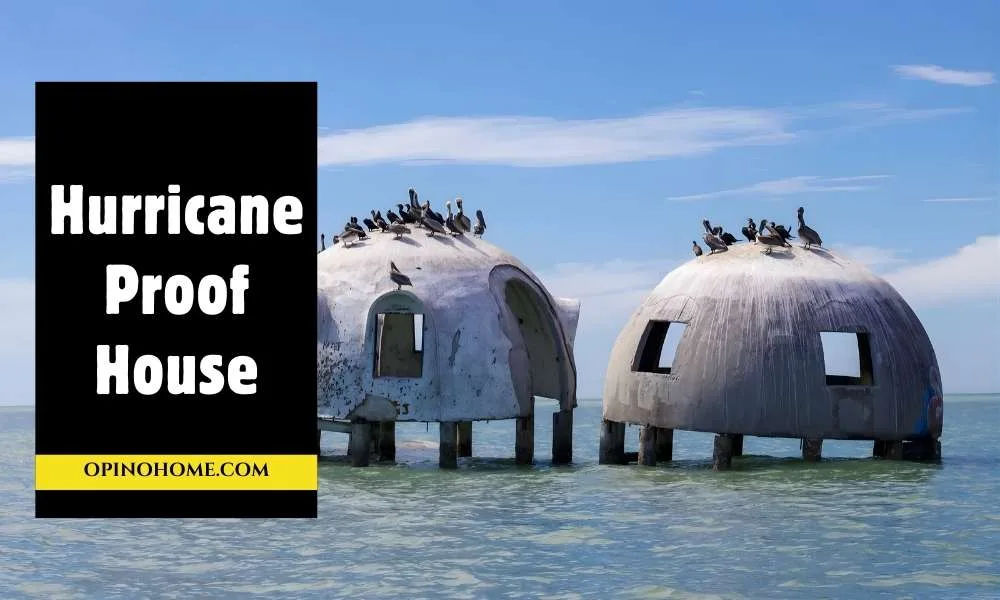
The iconic ‘Dome of a Home’ on Pensacola Beach uses 16 pilings driven 17 feet into the sand, allowing water to pass under the structure. Onx Homes raises foundations 5 to 7 feet above grade depending on flood zone. The Eye of the Storm on Sullivan’s Island uses eight large openings at ground level — five wide enough to drive through — so storm surge flows through rather than against the structure.
What Are Prefab Hurricane Proof Homes and Are They Worth It?
Prefab (prefabricated) hurricane proof homes are built in a factory and assembled on site. They are engineered to exact specifications, reducing the human error that causes failures in site-built homes. Studies have found that prefab homes can withstand hurricane damage more effectively than conventional stick-built houses when properly installed and anchored.

Deltec Homes builds round prefab homes in a facility in Asheville, NC, using machine-rated 2,400 psi framing lumber — twice as strong as typical framing material, plus 5/8-inch sheathing on exterior walls, roof, and floor.
Their homes have a 99.9% structural survival rate across every hurricane since Andrew (Deltec Homes). Bauhu Homes builds steel-frame modular homes for the Caribbean. Their first Jamaica villa, Xenjoh Villa, survived Hurricane Beryl in 2024 completely unscathed.
Onx Homes uses robotics and AI in a factory to pour monolithic concrete walls — no seams, no gaps. As of 2025, they have completed 700 homes in Florida with 2,500 more under construction.
What Are the Main Types of Prefab Hurricane Proof Homes?
- Round prefab (e.g., Deltec): Circular aerodynamic design, radial trusses, 99.9% storm survival rate. Available nationwide.
- Modular concrete (e.g., Onx Homes): Factory-poured monolithic concrete walls, built to Cat 5 standard (175 mph). Available in Florida and Texas.
- Steel-frame modular (e.g., Bauhu, Topsider): Post-and-beam or steel stud construction, non-combustible, termite-proof. Popular in the Caribbean.
- Dome prefab (e.g., Monolithic Dome Institute): Concrete airform dome, no separate roof to lose, extremely aerodynamic. Custom builds.
- Container-based kit (e.g., Out of the Box Building Systems): Ships in a container, assembles in 3 days. Category 5 rated, from $92,000. Available in Pensacola area.
How Much Does a Hurricane Proof House Cost?
Building a hurricane proof house costs more upfront than a standard wood-frame home. But the long-term savings from avoided storm damage, lower insurance premiums, and reduced energy bills typically make it the smarter financial choice over a 20–30 year period.

Hurricane Proof House Cost by Construction Type
The table below shows current cost ranges per square foot based on data from Concrete Network (HomeGuide.com), Home Nation, and industry sources (2024–2025 figures).
| Construction Type | Cost Per Sq. Ft. | Wind Rating | Notes |
| Wood frame + hurricane upgrades | $150 – $220 | Up to ~130 mph | Cheapest but least resilient option |
| Prefab poured concrete | $110 – $180 | 150+ mph | Good value, fast build |
| CMU (cement block) walls | $190 – $250 | 150+ mph | Common in South Florida |
| ICF (Insulated Concrete) | $120 – $230 | Up to 250 mph | Best energy efficiency + strength combo |
| Steel frame construction | $200 – $300 | 150+ mph | Non-combustible, ideal for coastal areas |
| Monolithic dome | $250 – $400+ | 300+ mph | Highest protection, unique appearance |
| Round prefab (Deltec) | $250 – $400+ | 130–190 mph | 99.9% survival rate, beautiful design |
A basic hurricane-resistant home averages $250–$350 per square foot. A 1,500 sq. ft. home would cost roughly $375,000–$525,000 to build new. A prefab kit option (like Out of the Box Systems in Pensacola) starts at $92,000 for a 3-bed/2-bath model.
What Additional Costs Should You Budget For?
| Upgrade Item | Approx. Cost | Why It Matters |
| Impact-resistant windows | $40 – $55 per sq. ft. | Stop debris penetration, prevent pressure buildup |
| Hurricane shutters (whole house) | $3,000 – $15,000 | Added layer over windows and doors |
| Metal hip roof upgrade | $10,000 – $30,000 | Reduces wind uplift vs. standard asphalt shingles |
| Hurricane strapping (retrofit) | $500 – $2,500 | Ties roof trusses to walls and foundation |
| Elevated foundation (pilings) | $15,000 – $40,000 | Protects against storm surge flooding |
| Whole-house generator or solar + battery | $8,000 – $25,000 | Keeps power on after extended outages |
| Reinforced garage door | $800 – $2,500 | Garage doors are a top failure point in hurricanes |
The good news: hurricane-resistant homes typically qualify for lower homeowner’s insurance premiums. In Florida, this can save $1,000–$5,000 per year — covering upgrade costs over time.
What Makes Hurricane Proof Homes in Florida and Pensacola Beach Special?
Florida leads the United States in hurricane proof construction. After Hurricane Andrew (1992) destroyed over 63,000 homes in South Florida, the state completely rewrote its building code. Today, Miami-Dade and Broward Counties have the strictest residential construction standards in the country — the High Velocity Hurricane Zone (HVHZ) code.
Florida homes built to HVHZ standards require: cinder block or CMU masonry walls reinforced with concrete pillars, hurricane-strapped roof trusses, missile-impact-rated glass, reinforced adhesives, and specific types of roofing. The median cost to build a new home in Florida is around $415,000 excluding land (Synergy Homes FL, 2025).
Hurricane Proof Homes in Florida — Who Builds Them?
- Onx Homes: Builds monolithic concrete homes rated for 175 mph winds. Active in Cape Coral, Punta Gorda, Lehigh Acres, and Central Florida. Starting in the high $300,000s.
- Deltec Homes: Round prefab homes with 99.9% hurricane survival rate. All 26 Deltec homes on Black’s Island, Florida survived Hurricane Michael without structural damage.
- Spray Rock: Uses gunite (concrete spray) over steel frames. Builds across South Florida’s most hurricane-prone areas.
- Topsider Homes: Post-and-beam pedestal homes on pilings. Have survived direct hits from Dorian, Hugo, Ian, Andrew, Katrina, and Milton.
What Is the Famous Hurricane Proof House at Pensacola Beach?
The most famous hurricane proof house in Pensacola Beach is the ‘Dome of a Home’ — a monolithic concrete dome at 1005 Ariola Drive, built in the early 2000s and designed by architect Jonathan Zimmerman. It sits on 16 pilings driven 17 feet into the sand and is designed to withstand winds up to 300 mph. The dome is 3,200 sq. ft. with four bedrooms and three bathrooms.
The home survived Hurricane Ivan (Category 3, 2004) and Hurricane Dennis (Category 4, 2005) with only minor wet floors. NBC News embedded a crew inside the home during Ivan. After Ivan, the surrounding barrier island was completely submerged — but the dome stood undamaged. FEMA approved the design and even provided a small grant toward its construction. The home was later featured on The Weather Channel, the Travel Channel, and HGTV.
A second example: Out of the Box Building Systems introduced container-based prefab homes to the Pensacola area in 2019 — a 3-bed/2-bath model costing $92,000, built to Category 5 standard and assembled on site in just three days.
Famous Real-World Hurricane Proof Houses: Sullivan’s Island and Jamaica
Here are some of the real-world Hurricane Proof houses.
What Is the Hurricane Proof House on Sullivan’s Island?
The most famous hurricane proof house in the world may be the ‘Eye of the Storm’ — a monolithic concrete dome at 2851 Marshall Boulevard on Sullivan’s Island, South Carolina, just 230 feet from the beach.
The home was built in 1991 by George Paul for his parents, Huiet and Helen Paul, after they lost their previous home to Category 5 Hurricane Hugo in 1989. Architect X Dilling of the Isle of Palms designed the shape: a horizontal prolate ellipsoid (the shape of a watermelon) 80 feet wide by 57 feet deep — the first ever built in this form by the Monolithic Dome Institute.
Key structural features of the Eye of the Storm:
- Weighs approximately 650 tons (1.3 million pounds) of concrete and steel — no wind can shift it.
- Monolithic shell — no separate roof. The dome IS the roof and walls in one continuous piece.
- Eight large ground-floor openings (five wide enough to drive through) allow storm surge to pass safely underneath the living levels.
- Second and third floors are suspended from the dome shell, with no load-bearing columns below.
- Hurricane shutters built to withstand winds up to 150 mph can close over the recessed beach-facing windows.
- Civil engineer Rick Vognild of the Southern Building Code Congress confirmed the aeronautical design can withstand hurricane-force winds.
The home sold for $4 million in 2019. It had been listed at $4.9 million — making it one of the most valuable properties in South Carolina’s wealthiest ZIP code.
What Does a Hurricane Proof House in Jamaica Look Like?
Jamaica sits directly in the Atlantic hurricane belt and is hit regularly by major storms. Building hurricane proof in Jamaica requires both smart design and compliance with Jamaica’s national building code, which specifies wind load requirements based on location and elevation.
The most notable recent example is Xenjoh Villa — a 7-bedroom, 7.5-bathroom luxury villa built by Bauhu Homes on the Jamaican coast. The villa was completely unscathed when Hurricane Beryl devastated much of the island in 2024. It was the first Bauhu steel-frame modular villa built in Jamaica and is described as ‘seamlessly blending contemporary design with the natural beauty of its surroundings’ (Bauhu Homes).
For anyone building a hurricane proof house in Jamaica, experts recommend:
- Reinforced concrete walls — the standard best-practice material in the Caribbean.
- Elevated site selection — avoid coastal flood plains; build at higher elevation where possible.
- A robust reinforced concrete or metal roof designed for high wind and flying debris loads.
- Impact-resistant windows and doors — flying debris from neighboring structures is a major hazard in dense areas.
- Work with a Jamaican structural engineer and confirm compliance with the Jamaican Building Code (JBC).
The Caribbean hurricane-proof housing market is estimated at over $500 million annually and growing at 8–12% per year, driven by increasing storm intensity and stricter building regulations across the region.
Can You Buy a Hurricane Proof House for Sale?
Yes. Hurricane proof homes are available for sale in Florida, the Carolinas, the Caribbean, and other storm-prone regions. Here is where to find them and what to look for.
- New construction from specialist builders: Onx Homes (Florida, starting high $300,000s), Deltec Homes (nationwide, custom pricing), Topsider Homes (custom coastal pedestal homes in Florida, Bahamas, Caribbean).
- Resale of proven homes: The Dome of a Home on Pensacola Beach has been listed for sale. The Eye of the Storm on Sullivan’s Island sold for $4 million. These properties advertise hurricane survival records as a selling point.
- MLS and Zillow searches: Search ‘hurricane resistant’ or ‘storm-resistant’ in Florida MLS systems. Look for homes listing ICF construction, concrete block (CBS), impact windows, and hip roofs as features.
- Caribbean specialists: Oceanside El Salvador, Bauhu Homes, and Topsider Homes all list hurricane-resistant homes for sale in the Caribbean and Bahamas.
When evaluating a hurricane proof house for sale, always ask for: the wind rating certification, the foundation type and elevation certificate, the window and door impact ratings, and any post-storm inspection reports confirming the home performed as designed.
How Do You Build a Hurricane Proof House for a School Project?
A hurricane proof house school project is a common STEM assignment that tests structural engineering principles using simple materials. The goal is to build a small model house that survives a simulated wind test — usually a fan or hair dryer on high setting, sometimes combined with a ‘rain’ test using a spray bottle.
Best materials for a hurricane proof school project model:
- Popsicle sticks or balsa wood for the frame — light but strong when joined correctly.
- Hot glue for all connections — creates rigid joints that resist racking.
- Cardboard or foam board for walls and roof sheathing.
- A low, four-sided hip roof — avoids flat gable ends that catch wind.
- Toothpick or skewer cross-bracing inside wall panels — acts like shear walls.
Step-by-step build process:
- Build a solid rectangular base from stacked layers of cardboard or plywood. This is your foundation.
- Construct four equal wall frames from popsicle sticks or balsa. Add diagonal bracing inside each wall panel.
- Hot-glue walls to the base at every contact point. Do not leave gaps.
- Add a hip roof — four sloped triangular panels meeting at a center ridge. Avoid a flat or gable roof.
- Cover the roof panels with cardboard and seal all seams with hot glue or tape.
- Wrap the exterior with a thin layer of craft foam or heavy paper for ‘sheathing.’
The key design lessons this project teaches: shape affects wind pressure (round and hip-roofed structures outperform square with gable roofs), connections matter more than materials (a weak joint is the first failure point), and the foundation must anchor everything — even a strong structure fails if the base lifts or slides.
Final Thoughts: Is a Hurricane Proof House Worth Building?
If you live in a hurricane-prone area, building or buying a hurricane-resistant home is one of the smartest long-term investments you can make. The upfront cost is higher — typically 15–30% more than a standard wood-frame home. But you gain: a structure far more likely to survive a major storm without significant damage, lower insurance premiums year after year, and the ability to shelter in place instead of rebuilding from scratch.
Start with the right shape (round or square with a hip roof), use reinforced concrete or ICF walls, protect every opening with impact-rated windows and shutters, tie the roof to the foundation with continuous strapping, and elevate the foundation if you are in a flood zone. Done right, a hurricane proof house is built to last 50 to 100 years — through whatever storms that future holds.
Frequently Asked Questions
Q. Can you actually build a 100% hurricane proof house?
No home is completely hurricane-proof against every possible storm. However, modern concrete and dome homes can be built to survive direct hits from Category 4 and 5 hurricanes with no structural damage. The term ‘hurricane-resistant’ is technically more accurate than ‘hurricane-proof.’ The goal is to build a home that keeps its occupants safe and remains livable after the storm.
Q. What is the most hurricane proof house shape?
Round and dome-shaped homes are the most resistant. The circular form reduces wind pressure by around 30% by redirecting wind around the structure rather than stopping it. Monolithic concrete domes are considered the gold standard — one continuous piece of concrete with no seams, no separate roof, and a curved shape that deflects wind in all directions.
Q. Are hurricane proof homes more expensive to insure?
No — they are typically cheaper to insure. Homes built to higher hurricane standards qualify for discounts under the Florida Building Code and similar state programs. Insurers in high-risk states like Florida, Louisiana, and Texas charge significantly lower premiums for homes with impact windows, hip roofs, reinforced garage doors, and concrete construction. Some homeowners save $1,000–$5,000 per year on premiums.
Q. What is the best roof for a hurricane proof house?
A hip roof at a 4:12 to 6:12 pitch is the best choice. It slopes on all four sides, leaving no flat gable ends for wind to push against. A metal roof — properly installed with hurricane clips and sealed decking — adds extra wind uplift resistance. Heavy concrete or clay tile roofs also perform well when installed with hurricane straps and clips, though they add significant structural load.